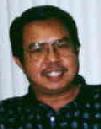
The Author
The Author
My first recollection of my childhood was in June of 1955. It was my first day of school in Grade One. I was very nervous, yet very excited because I finally would be in school, like all my elder brothers who had gone before me to the same school, the Butong Elementary School in Butong, Taal, Batangas. The school was only about five minutes walk from our house, yet it could not be easily seen because of the houses and bushy trees between them. The sound of the bell before and after school classes could be heard though, in most days, when weather was good.
It was a pleasant day as I remembered it, like any other day in the beginning of the month of June, a beginning of a new season after a long summer (March to May). Soon the rainy days would come and the rice planting season would began.
Butong School was only about 10 years old at that time. It was built when World War 2 ended. It started out with only four grades, grade 1 to grade 4. Grades 1 and 2 rooms were in the same building and built with concrete floors at grade level, wooden walls and nipa roofing. Grade 3 and 4 rooms were also in one common building, located facing the main road, a distant away and east of Grade 1 and 2 building. They were built with elevated wooden floors, wooden walls and corrugated iron roofing. The floors were about four feet off the sandy sand and underneath was where we spent a lot of our recess time playing and getting shade from rain and blistering heat of the sun. At the entrance to the school compound stood the statue of Francisco Balagtas, a Tagalog poet and one of Filipino heroes. There was a toilet building with no plumbing, located along the fence between the two school buildings. There was a boy and a girl washroom in that building, elevated a few steps of stairs to accomodate the waste containers underneath. The walls and roof were made of corrugated iron sheets. It stunk even though students took turns washing them down everyday, probably because the container room was not sealed and partly because a lot of boys urinated around the outside of the building all the time. There was only one manual deep well water pump installed behind the grade 3 and 4 building. There was where we got our drinking water, as well as the supply for watering our plants in the garden.
I still remember how we learned to read and write under the guidance of Miss Lualhati in Grade1. The "Pepe and Pilar" was our first book and the characters were the model of our childhood. I had my first fist fight with another kid in Grade 1. He was much bigger than me. And I could still recall the pain when I got hit a few times. We later became good friends until our graduation day in grade 6, where we went our separate ways. It's in Grade 1 where a lot of children had problems adjusting in their daily chores. A number of kids had problem controlling their bowel movement while others just got homesick and cried after a few hours in school.
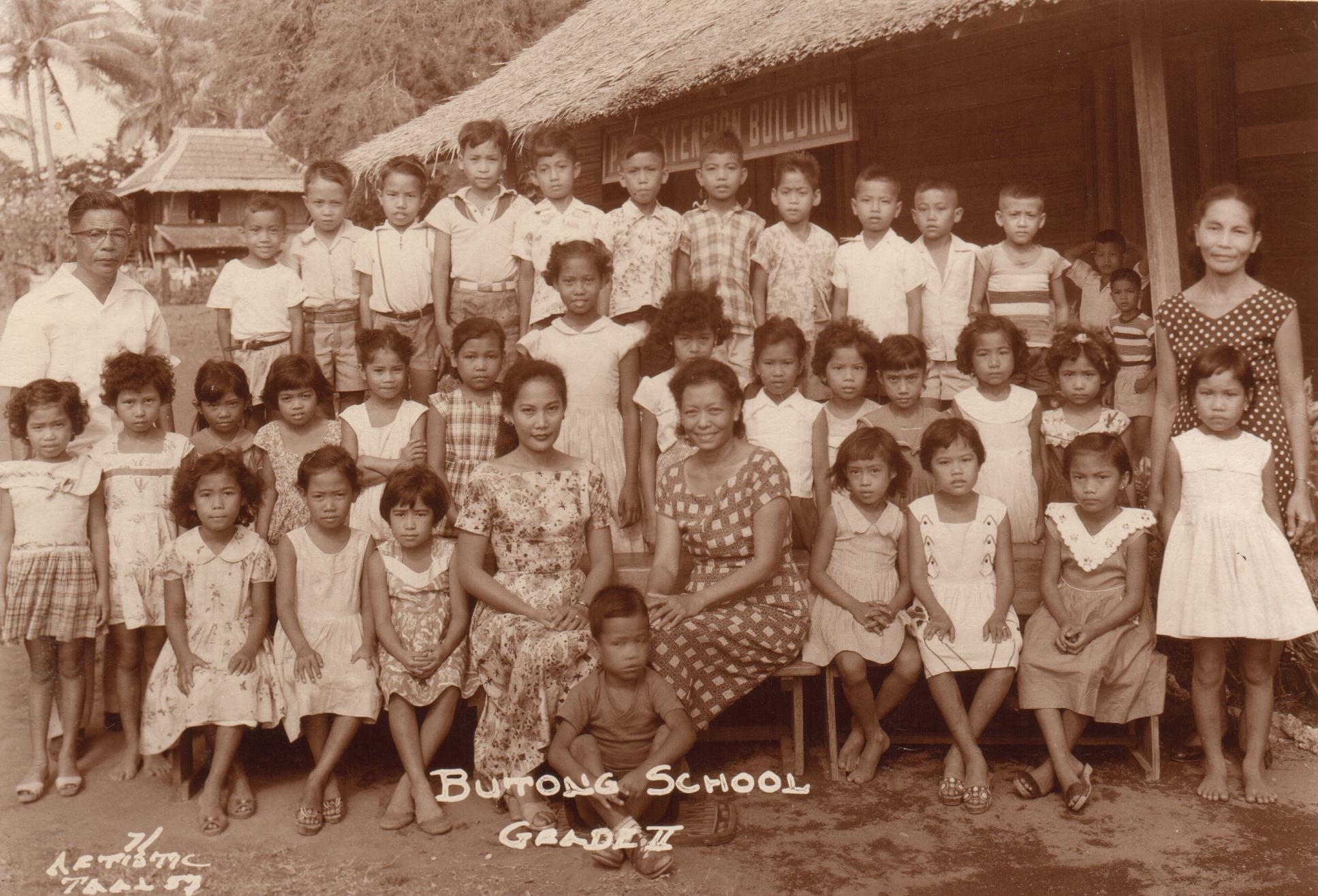
My Grade 2 Class
Mrs. Atienza of Grade 2 class provided us with our first taste of mathematics and good story readings. We were also taught cleanliness. Anybody would get spanking on the palm of his or her hand if he or she was dirty or when the fingernails were long. Every so often we took all our desks out of the room and washed them down and cleaned them with "as-is"(a broad plant leaf with a rough surface used for cleaning wood). We also learned how to cut grass using "karet" and gambled the grass clippings among ourselves to get more of them so as to avoid more work, because the teacher would check everyone's grass clippings later to prove that we did our share of work.
Mrs. Cheling De Villa of Grade 3 taught us social studies and sciences. We also learned music and drama, particularly in Christmas concerts and graduation ceremonies. I participated in a play about Jesus' birth in Bethlehem as one of the three wise kings. I also recalled being in one of the "Pandango sa ilaw" folkdance performances on a graduation day. All concerts and programs were held on the concrete stage in-front of the grade 3 and 4 building facing the main road.
Mr Fidel De Villa, the Grade 4 teacher and our Principal taught us history, mathematics and woodworking. He was very strict and a desciplinarian. Being a product of the Spanish and American education system he used descipline deligently in his teachings. He would grab and pull anybody's side burn if he or she disobeyed or distracted the class. Spanking on palms or pinching on the arm were minor penalties. Mr. De Villa was the pillar of Butong School and continued to teach class even as a principal, and until his retirement.
In 1964, Butong School became Butong Elementary School after the addition of Grade 5 and 6. Our class became the second batch who graduated from the school. Before then, Butong students had to go to the neighboring Taal Elementary School (Building 2) to finish Grade 5 and 6. Building 2 was located in the poblacion (town proper) up in the hill and one had to climb up at least 100 steps of stairs from the gate by the roadside to reach the building porch.The town's Grade 1 to 4 class rooms were in another building (Building 1) which was located next to the Taal church in the east end of town. All my brothers before me studied in Building 2.
There were a number of activities in Butong school that I could not forget. Playing in the huge school ground (it seemed bigger then when I was a kid) was our joy. We would have running race, climbing the mango and tamarind trees or hiding under the grade 3 and 4 building, catching "korokya" (small ground bug) or just talking. We enjoyed growing tomatoes and eggplants in our gardening class. Every year, every boy in the woodworking class had to bring a tree trunk ("pamupoy") to replace the school's wire fence posts. Christmas programs and graduation ceremonies were something to look foreward to every year. Visit of the dentist in the school and forced drinking of government supplied milk were a bore. Some boys, like our class, started to smoke cigarettes in our final year. And boys started to have interest in girls in the final year, after years of segregation and indifference between them.
Butong is a barrio of the town of Taal in the province of Batangas. It is located in the southern region of Luzon, one of the three main regions of the Philippines (Luzon, Visayas and Mindanao). It is about 100 km south of Manila and is accessible through the south superhighway and mostly paved roads with some bad sections, especially as you entered the town of Cuenca. Going by Tagaytay route is longer, but has better roads and some good sightseeing spots.
Butong lies between Taal and neighbouring town of San Luis. The name Butong apparently came from a nut-bearing tree named Butong, which were abundance in the old days, although. I had never seen a Butong tree in all my years of growing up there. Also, history indicates that most of now Butong was once under water, but water receded farther and farther away towards the west for years. This explains why the eastern part is up on the hill ("Ibabaw") and about 40 ft from the Butong mainland. Apparently the abrupt change in elevation was where the waves used to break as it rolled toward the beach. There was also a huge (about 15 ft high) rock near the foot of the hill at one time that broke off from the hillside and became Butong's landmark at the Taal-Butong border. I spent a great deal of time with friends up on that hill to play and pick guavas, "kamatchile" and corn in the fields of Ka Ido or Ka Ises, two of Butong's famous farmers at the time.
The Butong beach, aside from being the favorite picnic site by the city dwellers during summer, had a memorable history. The Butong Sea Breesze Resort became the American Soldier's Entertainment Club House during World War 2. American soldiers from all over the country came there for vacation or a break from duty during the war. My father worked at the club as an interpreter between the Americans and the locals during that time.
Butong's economy was booming during the 50's and 60's.. Fishing brought prosperity to its people. A number of local people were able to afford big boats for commercial fishing ("basnit"). People from other towns and provinces were lured to work for the boat owners and lived in Butong. Fisherman from as far as the Visayan province came to the barrio to fish. They were experienced divers who caught fish underwater by sling spear. They also introduced new methods of fishing and way of life to the locals. Most of them eventually became resident of the barrio for good.
The barter system ("palitan") was very much alive in those days. Farmers from the eastern part of Butong (Ibabaw & Ipil) and from the neighbouring town of San Luis would flocked to the beach of Butong in the early morning hours to wait for the fishing boats to arrive after all night fishing in Butong's waters, the Balayan Bay. They would trade their produce for fish. Vegetables, eggs, peanuts, yam, cakes, pudding, and sticky rice in banana leaves ("suman") were the farmers' common trade goods. While tuna ("tuli-ngan"), blue fish ("galunggong"), butterfish ("hiwas), marlins ("tambakol") and small fish ("dulong") were the fishermans' common catch of the day. A lot of kids who attended Butong School worked for commercial fishing boats ("basnitan") at night and normally brought a lot of farmer's produce to school after they traded-in their share of fish. Two of my brothers had experienced working for these commercial boats only for a short while because work in the sea at night was too tough for them, especially when the weather was bad. There were no cabins in those boats, so they were exposed to cold wind and rain. Workers received their earnings when the season ended, where the owner took a portion of the total earnings and divided the rest among all the workers. In additon, each would be given a small portion of the catch everyday while the rest would be taken to the market to sell. Fish in bamboo baskets ("bakol") or wooden boxes were normally taken to the neighbouring markets of Taal & Lemery by horse-drawn buggies ("Kalesa") and lately by tricycle ( motor bike with side-mounted car).
"Basnitan" is a method of fishing where fish are lured by light. The boat carries a number of kerosene-fueled lantern (Coleman) and position them around the boat to attract fish. Locating the school of fish could be difficult at times. Therefore, they usually need the help of an independent on-looker ("maninilaw") that carry one or two lamps to locate fish and then anchor the boat to that location upon the on-looker's signal, usually done by raising and lowering the lamps. The on-looker got paid according to the amount of fish caught. The fish were caught by net lowered to the water on one side of the boat by a number of workers standing along the boat and raised it up when the fish were contained.
Another method of fishing which was very popular in those days was called "Sapyaw". This type of fishing was usually practiced during the day and during the high tide season ("habagat"). They used bait, which was ground fish, usually from the previous catch. It also uses a net, but smaller than the one used by "basnitan". The boat was also smaller and workers were only four to six in number. They could make 2 to 4 trips to catch fish a day. However, the catch was very limited to certain types of fish, normally "galunggong".
Butong was the most prosperous and the most populous barrio of Taal in those days. It had also the most number of students in high schools and in the universities, mainly in Manila. It was become the most sought about territory on votes for politicians. However, the barrio was often divided in its support for political candidates. There were a number of political campaign leaders. Among them were Nicasio Maranan (Butong;s Barrio Captain in the 50's) Artemio Tamayo (Butong's Barrio Captain in the late'60's), Fidel De Villa (Butong School Principal), Max Paala from Ilaya and Briccio Cauntay (Taal Elementary School Teacher) to name a few. Even my father was considered a leader because if his good standing in the community where a lot of people asked him for advise. However, he tried to maintain a low key because he was a government employee and therefore, by law he was not allowed to participate in any political campaign. Later on, it was my brother Antonio Jr.who became active in politics in Taal.
Butong was always divided socially in its history. People of the the South (Ibaba) was usually in conflict with the people of the North (Ilaya). There was rivalry between them since the beginning of time, probably because of their social and financial differences. Most people of the north were fishermen who earned seasonal living , while a good number of people from the south were employed by companies in town or in Manila, therefore, they were well off financially. Youngster from "Ibaba" wore more contemporary clothes than their counterparts in "Ilaya". And the south seemed to be the center of all social activities. Not only that the community center and the church were in the south, but the youngsters in the south seemed to enjoy socializing more, influenced by the city's way of life where many of them worked and went to school.
I grew up in the middle section (Gitna) of Butong, although most people considered us to be part of "Ilaya". Our youngsters hanged out mostly in "Ibaba" and members of social clubs there, namely, The Young Heart's, Tigalpo, Breezers' Sr., Breezers' Jr, Dribblers, Butong United Youth, and many more. Our favorite hang out places were the basketball court ("basketbolan") where kids just took turns shooting the ball , Angge's Variety Store ("Tindahan Ng Nanay Angge") where kids sat on bamboo bench, smoking, talking or just hanging out to meet people who came to buy something from the store, and the bingo parlor either in "Ka Brik's" store or in "Nanay Angging-Martin's" front yard. During our summer vacation we frequently hanged out at Butong's beach resort, the " Sea Breeze", swimming or just talking and watching people that came from around neighboring towns and from as far as Manila. Social dancing was very popular and frequent. All it took was a record player with amplifier ("Am-ple"), some lighting and some light refreshment. Group drinking of either beer, rum, whisky or "lambanog" (palm tree rum) were also the joy of some youngsters, especially when a resident of the barrio just came back home from a long absence or when there was a visitor in the barrio.
Our house when I was growing up was a mix of Spanish and native design. The roof had a long spear, a Spanish design which served as a lightning rod. The front had a concrete stairways leading to a porch, then a wooden stairs leading to a balcony. The concrete stairs and the porched were lined with flower pots along the sides. There was a storage for shoes and slippers along one side of the wooden stairs.The balcony was sorrounded by waist-high wooden sidings and iron railings extending up to the ceiling. There were rolled up tarp all around top of the railings which were lowered during heavy rain and storm to prevent water coming in. A large double swing door lead to the house . The flooring of the house were all bamboo slats, polished and coated with varnish, except for the kitchen. There were two bedrooms only. One of them had a bed and was my grandfather's room, then later became a room for the eldest sibling in the family whoever was there at that particular night. The other room served as a closet for all our clothes as well as storage for the dirty clothes hamper. Once in a while somebody slept there, but most of us slept in the living room while Tatay & Inay (Mom and Dad) slept in the "komidor" , the room between the living room and the kitchen,. The"Kumidor' was where we had a little altar for worship where we prayed together every evening before supper. This room also contained our book cabinets and my mother's sewing machine. The dining room had a long dining table for about ten people with benches around it. Everybody in the family had his own permanent seat around the table. On one end of the room was a food counter and a cabinet for leftovers and cooking utensils. On one corner is a big rice box ("baul") which served as extra table or bench. The kitchen ("Batalan) contained a wood burning stove, a dish washing sink, dish racks and a big drinking water jar. We used to fetched water from a manual pump in the bathroom downstairs using a big tin can and moved it up the bamboo-made stairways to the kitchen. That kitchen was later innovated during my teens, where a hand pump and a big drum were installed up in a tower outside the kitchen wall, and the floor and stairs were poured concrete. It was my chore at one time to pump and fill that water supply tank every day after school. Everybody in the family had his own chore until he graduated from high school and left to study in the university in Manila. Somebody would dispose the urine basin ("arinola"), while another would feed the chicken (chicken were on loose in the yard) or the pig, and another would clean the house or sweep the ground around the house. Cutting firewood and cleaning cooking pots (they were dragged on the sand and used coconut husks and sand or steel wool to clean) were occasional chores shared by the younger siblings. We would sometimes go out and pick-up firewoods in the bushes and sometimes assisted my mother doing the laundry in the river nearby. Laundry became a picnic when we brought food to the river for lunch.
Our family had its share of bussiness ventures. My brother Ernesto tried vending popsicles in the streets of Taal & Lemery as a kid for extra cash. I sold lottery tickets in my high school years all around Batangas and Quezon city during summer vacations. And my brother Jim would show magic and home-made puppet or silhouette movies to local kids for a fee of a few sticks of matches, which were a very important aid for cooking in our home in those days. However, nobody in the family really made it into the big league.
There were a number of entertainment for the kids of Butong in the 50's and 60's. For the very young (pre-schoolers) trading and gambling with shells ("sigay") was popular. For the elementary school kids, playing cards with their favorite comics characters was a hot item. Each player would throw all the players' favorite cards up in the air and whoever's card turned upside up, won and collected winnings from the other players. Gambling with multicoloured rubber bands ("lastico") was big time, and was played in several different ways. One way was to tie up all the players' elastics into one bunch and each player take turns kicking them up until they loosened and got separated. The person who kicked them loose, won. Another way was burying all the players' elastic in the mound of sand and each player took turn hooking them up with a stick until all elastics were recovered . The most popular way was betting with the use of shells or dice. There were two main players in the game but could have as many side-bet players, all formed a circle while playing. Elastics were in hundreds, normally tied together in multiple chain links.
Another game kids played was "Holen", a game that resembles a 9-hole Golf game without a club. The player used about half-an-inch diameter marble and with the flick of his thumbnail while in the squat position would try to get his marble into a series of holes on the ground. Each player had the option of knocking down his opponent's marble by hitting it out of the playing field. Whoever completed all the holes first, won. The bet was usually hitting the loser's knucle with a marble.
During the easter holidays, the kids played "Tuktok", a game between two players where they hit each other's chicken egg at the pointed end . The player with an undamaged egg won and would take away the loser's egg as the winning.
Another game was called "Huyo" which resembles the game of Curling , where several players , each with a flat-shaped rock would try to get it into a circle or knocked the opponents' rocks out of the circle.Then there was the" Hide-and-Seek" game which was usually played at night and enjoyed by teens, boys and girls.For the tough kids, there was the "war game" where the players used elastic gun and tightly-rolled & bent paper bullets. The players were grouped in two teams and a player was eliminated out of the game when hit by the bullet. The surviving team won the game.
My playmates' favorite past time when I was a kid was a trip to Ibabaw to pick "Kamachile" or "guavas" and camped there all day long. The fruits were free for picking although the trees were owned by the farmers living there. During summer we would cut sugar canes and chewed them up in the bushes or in the nearby river. Kids were sometimes got carried away and picked corn cobs which were the farmers' main source of income. The farmers would chased the kids away for miles, a scenario that kids enjoyed very much. Sometimes, we would go hunt for birds using our pebble-armed sling shots and traps called "bantay"(a slender bamboo pole with pointed end and a hole near the tip where the looped string, which is connected to the other end with a rubber strip, goes through and held by a cross-formed sticks. When the bird tried to land there to eat the bait,usually a fruit, the sticks would fall and the string would catch the bird's feet as the string is pulled by the elastic's force.) The birds we used to hunt in those days were: "Maya" (sparrow), "Kasay-kasay" (kingfisher), "Pugo" (quail), "Pakis-kis" and "Pulanga"(oreol?)
Free movie showing at the plaza sponsored by drug companies promoting drugs like " Cortal"(for fever and colds) and "Philip Milk of Magnesia" (for diarria) is a treat for the barrio residents. People brought their own chairs and sometimes umbrellas to keep them dry when it rained. Cowboy movies were peoples' favorite, although any movie would give them joy of their lives.
"Fiesta" in the barrio is an annual gathering looked forward to by the residents and guests from the neighboring barrios and towns. It is a day celebrated for the patron saint of Butong, St. Peter. Most people spent a big chunk of their savings while others made loans to serve food to their guests on that special day. There were hired musical bands that paraded the barrio all day long and the day before ("bisperas"). There were amateur singing contest, rides, gambling boots , stage plays and the prosession of the patron saint and devoted followers. The streets of the barrio were decorated by pendants and banana trees. The expenses were paid for by the money collected by the fiesta committee and by the money donated by the politicians and social clubs of the barrio.
"Santa Cruzan" is another big event in the barrio during the month of May. It is a celebration of the "cross".in the form of a procession of nicely dressed children, teens in princess costumes and their escorts followed by the patron saint and a choir singing Spanish songs like Hail Mary. The procession started from the chapel and ended at the church after the round of the streets of the barrio. It was held every night for the whole month of May and ending was associated with fireworks display.
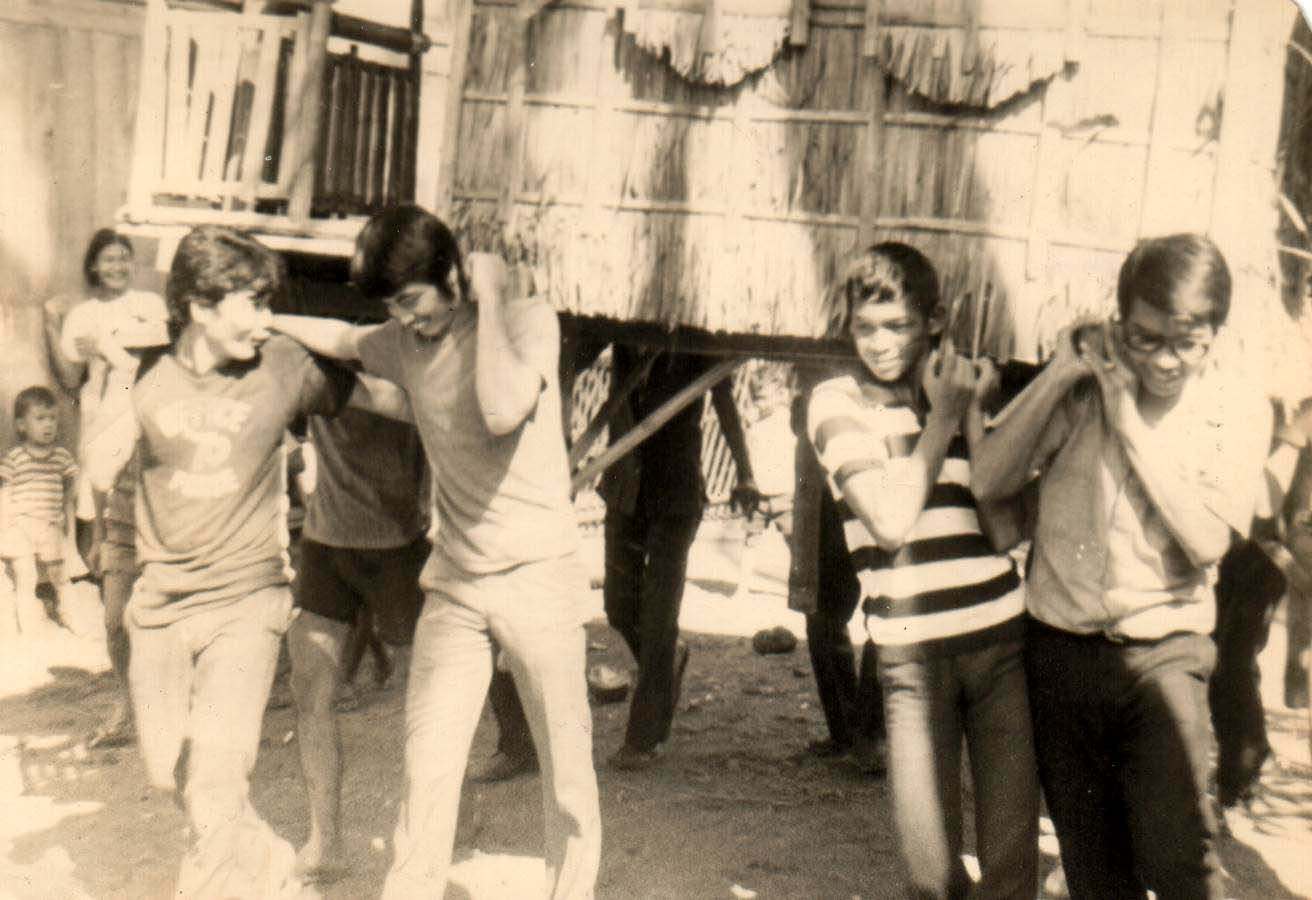
On All Soul's Day, a youth group transporting a whole nipa house as part of a pa-Tumba.
All Souls' Day, celebrated on November 1st, is one of the biggest event of the year. It is the day when people flock to the cemetery to remember their dead relatives. They bring flowers, candles and food and lay them on the tombstones of their departed love ones as offerings. But the event is generally becomes a reunion party for relatives and friends in the memorial park or cemetery. The old people pray while the teens chat, play games and sing,We used to enjoy collecting candle drippings and made them into a ball when we were small. We sometimes used these balls to polish floors as floorwax.In the evening, youngsters go from house to house to sing carols and eat food especially prepared for the occasion.Then late at night, group of single boys would go and steal everything they come across: fruits, plants, flowers, slippers, benches, canoes, clothes lines, nipa huts, snd delivered them to the front yard of one of the boys' fiancée as a token of his love to the girl. This practice is called "Tumba", and it is an old tradition which is only practiced in the barrio of Butong, Taal, Batangas. "Tumba" is supposed to be a surprise offering and will only be viewed by the girl the following morning, so it is important that the preparation is done quietly and secretely. The goods were later picked up by their owners by mid day without hurt feelings.
Christmas carolling of groups of youngsters and social clubs of Butong was an annual activity during the holiday season. They went from house to house singing Christmas songs in return for small donations for the groups' fund raising . This tradition as well as the Christmas songs played on the radio became the symbol of Christmas festivity in the barrio every year. Some radio stations in the country played Christmas songs as early as November.
New Years eve was usually celebrated with kids staying up late until the arrival of the New year. They roamed around the barrio and doing all kinds of activities, talking, playing bingo, majong, cards and firing bamboo made canons and firecrackers. Then at the tick of midnight they would gather together , form a parade and made all kind of noisies - shouting, hitting tin cans and dragging all kinds of objects on the street to make noise. Lately (from 1980 and on) one of the barrio's social club, "the Dalampasigan " hold a dancing ball every year around New Year's eve (the date varies so that it is held on weekends or on a day when most people of the barrio can attend). The club picks a new president every year to lead the celebration. My brothers and I became president of the club over the years.
All my brothers, cousins and I attended Batangas West High School in Lemery, Batangas. Only our youngest, Felicita and our girl cousins, Perla, Nenita and Esmeralda, attended high school at OLCA (Our Lady of Caysasay Academy) in Taal, Batangas, an exclusive school for girls.
Batangas West High is located in the northern part of the town, which in those days, almost the edge of town because most commercial establishment were in the south.It was traditionally, Butong childrens' high school, although most kids in Butong's North ("Ilaya") went to Rizal College in Taal poblacion. Batangas West High was a tough school in those days, where a lot of kids dropped out or changed schools after a year or two. And there were those students who had been here for years but could not passed the 4-year course. . The school was well known for having graduates most likely to finish colleges and universities. It had an outstanding teaching staff who were products of prestigious universities of Manila. There was Mr. Calixto Martinez, a master in World History. He knew history and map of the world by heart. He taught his subjects without notes and always presented them with enthusiasm. He continued to teach even after he became Principal of the school. Then there was Miss Agillar, the best English & Literature teacher you had ever met. A terror to some who didn't appreciate the subject and her work, but an eloquent speaker and a disciplinarian. She won't hesitate to belittle anybody in front of the class if he or she was not prepared for the day's class session. Every student play a part in dramas held in the classroom complete with custumes and stage settings. Another cornerstone of the school was Miss Rodriguez of the Biology class. A desciplinarian herself, who expected only the best from her students. I remember spending hours and hours in the laboratory trying to get those drawings right and the reports ready for the next session. In math and physics, Mr. Orlando Orlina was the school's best. He enthused his students with storiesrelated to his lectures and coupled them with drawings on the blackboard with dexterity, sometimes even with colored chalks which were very rare in those days. He knew his stuff very well being an engineering graduate from a prestigious school in Manila. Other teachers of the school who were cornerstones of Batangas West High were: Mrs. Enumerable, Mr. Ciriaco Lota, Miss Flor Medina, Mrs Orbita, Miss Teresita Lota, Mr Medrano (PMT), Mr. Matira (Agronomy), Miss Cresencia Lota (Principal) and Mr Maranan (P.E.).
Batangas West High School compound was surrounded with stores and eateries where kids spent their school breaks and lunch hours. Every group or kids from the same town or barrio had its own favorite store hangout. Butong kids hanged out at Nanay Angge's (De La Isla) Store across the street from the main road. The store which sold mostly soft drinks and lunch (vegetable or noddles) was located at the main floor in front of the house. The rest of the main floor was dedicated for kids' lunch storage which were the floor joists ("batangan") of the second floor. There was a long table behind the store where kids ate their lunches and did their homeworks. Kid's lunch from home usually consist of rice and fish (or meat) wrapped in banana leaves . Nanay Angge's hot vegetable soup augmented and warmed up these cold lunches from home at lunchtime.Nanay Angge seemed to remenber and liked every one of us, "De Las Alas brothers" probably because of our good behaviour in the store and our good standing in the school.
Next to Nanay Angge's store was "Ka Polo's Typing and Stenography School". A lot of Batangas West High graduates who did not want to go the university attended schooling there. In those days, a knowledge in typing and stenography would easily landed you a job in an office. Our adopted brother and cousin, Pablo Ocampo, is a graduate of Ka Polo and the first in the family to find a clerical job in Manila. Ka Polo, the owner was also a professional photographer for weddings and funerals.
Other famous places in Lemery in those days (50's and 60's) were: Correa's Hardware Store, Ilustre's Mansion, St Mary's High School, Mercury Drug Store, BTCO and United Bus Stations and Carandang Trading Store.
Our life in Manila was a very memorable one. Manila was the capital city of the Philippines since World War 2 and for a very long time. It was also the business capital of the country due to its high density of commercial businesses unmatched by any place in the Philippines, and most places in whole southeast asia. It has a number of prestigious colleges and universities where students from all over the country and from neighboring countries like Thailand, Hongkong and Taiwan attended.All my brothers, sister and I graduated from different universities in Manila. Our eldest, Bayani, finished Bachelor of Science in Chemical Engineering from the prestigious University of the Philippines; Antonio Jr. completed his law degree from the elite San Beda College; Ernesto graduated as a physician from the famous University of Santo Thomas; Jaime and I am were products of the top engineering school in the country, Mapua Institute of Technology; Reuben finished his medicine study also in the University of the Philippines; and our youngest Felicita is a Bachelor of Science in Commerce graduate of the exclusive De La Salle College.Our adopted brother, Pablo Ocampo, studied at Manila's biggest university, University of the East, but was forced to drop school after two years due to a serious illness.During our college days, we lived in Angalo, Binondo, Manila. It was located near "Delpan" (Manila Harbor) and a short distant away from Divisoria (market) , "Matadero" (Slaughter House) and the two southern Tagalog's bus terminals (BTCO and United Bus Lines). It was the center of many business establishment in the city : market, restaurants, hardware stores, mobile stores, newspaper stands, barbecue stands and sidewalk vendors of all kinds.We owned a small two-storey house in the heart of a previous slum area which later turned into a village and sold to poor people in the city. Running water was scarce in the area. We had to get up very early in the morning ( 3 to 4 o'clock) to collect water from the tap because nothing came out of the faucet during the day. Sewer system was inadequate and flooding was a common problem, especially when it rained. The main floor of our house was usually flooded with muddy water after a full day of rain. I remember times where I study my school lessons with the table and chair partially submerged in water. We used to go to school barefooted, walking through the flooded street and carrying our shoes until we reached dry land and put them on before riding the jeepney to school.Our house which although small and imperfect helped our parents brought us up in this hostile environment of Manila. It became a boarding house for our friends and relatives from our hometown in Butong. People from the province who came to the city for different reasons dropped by to say hello or spent the night before heading back home.
The house was run like a model school by my father and my uncle Pepito. My father usually did the groceries while uncle Pepito went out every morning to the marina to bring home fish to the dinner table. Everybody in the household helped out and shared the chores around the house, such as cleaning, cooking and getting up in the early hours to collect water from the tap for the day's use.
Angalo became a part of our lives - we made good friends there, my brother Bayani is the Godfather of one Manila policeman's son who lived nearby. My cousin, Rolly Mortel, met his wife there. And there were bad times too, like when my cousin Virgilio got mugged and beaten by tugs on the way home from work one night. My father was a victim of a pickpocketer while riding a jeepney. Luckily, my godfather who was a jeepney driver, was able to recover his wallet through his connection with the underworld in the city.And the worst of all when our house and the whole neighborhood were burned down by fire in late 60's. Luckily, our cousin, Teddy Maranan, was home at the time and was able to save some of our belongings with the help of our neighbors. That was the end of our lives in that area, the place was sold later by my father to start anew somewhere else.
Manila was the commercial and entertainment centre of the country before the birth of malls and huge plazas in Edsa, Pasig and Quezon City. People from all over the country came to Manila to find jobs and had a good time. Among the places the people used to go to were:- Avenida Rizal (Rizal Avenue), the street where most department stores and entertainment establishments were located.- Luneta Park (Rizal Park), the biggest park in the city and the place where Dr. Jose Rizal, the Filipino national hero, was executed by the Spaniards before the outbreak of World War 1. It was also the favorite place for the young lovers who like to spend the evenings alone in obscure areas of the park.- Quiapo, the oldest district of Manila and the home of the famous Quiapo Church and its patron, the Black Nazarene. People went there to pray for miracles.- Escolta, a place for the elite and people who have money to spend. The place was well known for its expensive shops.- Divisoria Market was famous for bargain prices and fresh fish, fruits and vegetables. But it was also well known for pickpocketers and racketeers. It was where my father used to buy our groceries. He had his favorite shop for dried fish, peanuts, hopia and sweet popped rice, During the Christmas Season, he would round them up for free calendars which he would give away to relatives and friends in Butong.
Movies were the favorite past times,especially for young lovers. There were at least 20 movie houses in downtown Manila alone during the 50's and 60's. People like them because of the comfort of the air conditioned room and the privacy it offered to young lovers who didn't want to be seen together in the street or in public places.
My work experience in Manila was numerous in a short period of 3 years. My first job after graduating college was an estimator for CM Lovstead (Smith Bell) Co, in Paranaque, Rizal. Then as a Control Engineer for Erector Construction Company in Cainta, Rizal. Several months later I joined General Electric Company in Paranaque as a Quality Control Engineer. With going abroad in mind, I then took apprentinceship at KwikWay Machine Shop in Navotas, Rizal . Finally, I work as a Mechanical Engineer for San Miguel Corporation Glass Plant while waiting for the approval of my application for immigration abroad.
I immigrated to Canada in the fall of 1973. My wife Lucy followed me in the fall of 1974. We lived in Thorncliffe Park Drive in Toronto for eleven years, then moved to our current address in Scarborough, Ontario, where we lived happily ever after with our three children, Mark Kevin and Jillian.